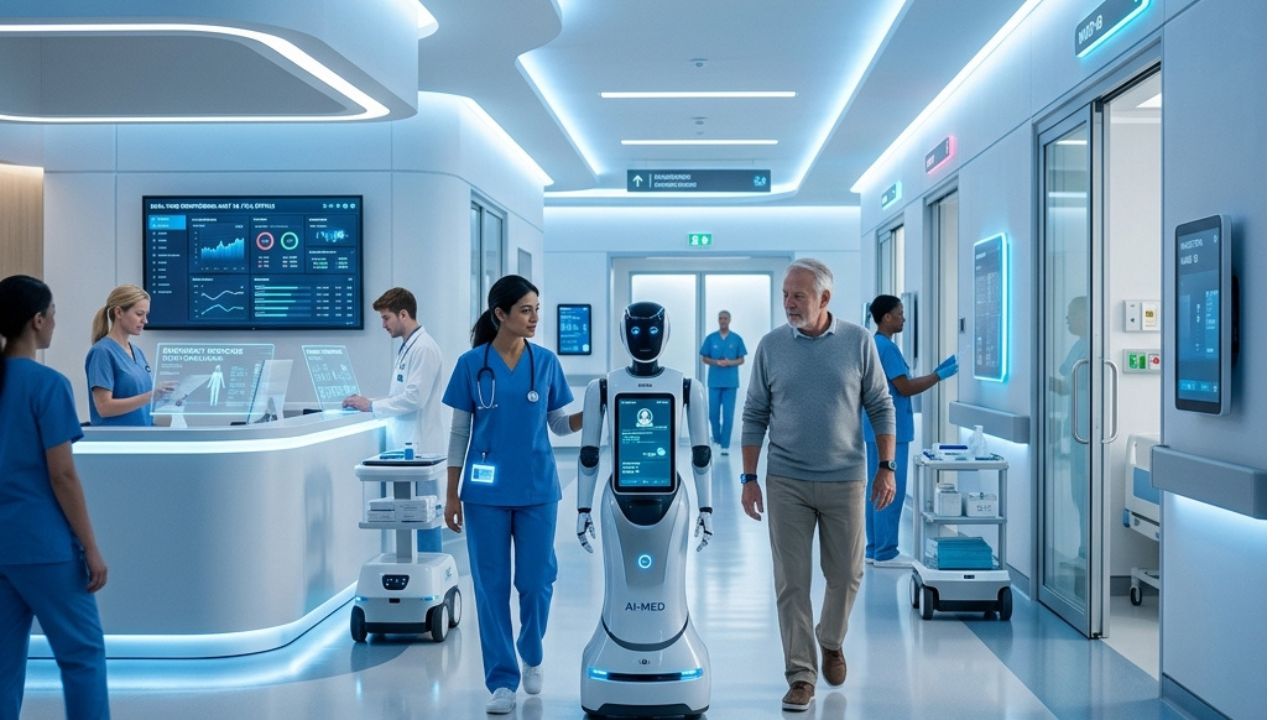
Hospitals are undergoing a massive technological shift, moving away from fragmented, paper-heavy systems toward highly connected, intelligent environments. Artificial intelligence sits at the heart of this transformation. By integrating advanced algorithms into everyday medical infrastructure, healthcare providers are redefining how care is delivered. This integration is creating a new standard for patient outcomes, operational efficiency, and medical innovation.
Artificial intelligence is fundamentally revolutionizing healthcare infrastructure. By connecting devices, analyzing massive datasets in real-time, and automating routine tasks, AI enables medical facilities to operate with unprecedented precision. These intelligent systems empower doctors to make faster, more accurate diagnoses while allowing administrators to cut costs and streamline facility operations.
This post explores the mechanics behind this technological leap. We will examine the current challenges straining modern medical systems and define what actually makes a hospital “smart.” From there, we will look closely at the specific ways AI contributes to diagnostic accuracy, treatment protocols, and daily hospital operations. Finally, we will address the ethical considerations of AI adoption and preview the future of intelligent healthcare ecosystems.
The Landscape of Modern Healthcare
Medical facilities worldwide face immense pressure. Growing populations and increased life expectancies have created a surge in patient volume that many hospitals struggle to manage. Administrators and clinicians must navigate a complex web of hurdles just to maintain a baseline level of care.
Operational inefficiencies often plague traditional hospital settings. Medical staff spend hours manually entering data, managing schedules, and tracking down equipment. These administrative burdens contribute heavily to rising healthcare costs, forcing facilities to allocate budgets away from direct patient care and toward backend management.
Data overload is another critical issue. Modern medical devices generate terabytes of information daily, from continuous heart rate monitoring to high-resolution MRI scans. Without the right tools to process this information, valuable insights get buried. Clinicians cannot possibly review every single data point manually. This overwhelming workload directly fuels staff burnout. Doctors and nurses are exhausted by the friction of outdated systems and the sheer volume of patients requiring attention.
Digital transformation offers a viable solution to these mounting pressures. Upgrading legacy infrastructure allows hospitals to automate tedious tasks, synthesize complex data, and ultimately return the focus to patient well-being.
Defining the “Smart Hospital”
A smart hospital is a healthcare facility that relies on optimized, automated processes built on an interconnected digital infrastructure. Instead of treating medical equipment, IT systems, and building operations as separate entities, a smart hospital links them together into a unified network.
This environment relies on several key components. The Internet of Things (IoT) provides the sensory network, connecting everything from patient beds to infusion pumps. Big Data infrastructure stores and organizes the massive influx of information these devices generate. Artificial intelligence acts as the brain of the operation, analyzing the data and making automated, real-time decisions.
The ultimate vision for future healthcare delivery involves a proactive, highly personalized approach. Smart hospitals aim to anticipate patient needs before they become emergencies, predicting disease progression and allocating resources efficiently to ensure seamless, continuous care.
AI’s Core Contributions to Smart Hospitals
Artificial intelligence provides the analytical power necessary to turn raw hospital data into actionable medical insights. Its influence touches almost every aspect of a patient’s journey and a facility’s daily operations.
Enhancing Diagnostic Accuracy
Medical imaging has seen some of the most dramatic improvements thanks to AI. Algorithms trained on millions of previous scans can detect minute anomalies in X-rays, MRIs, and CT scans. In radiology and pathology, AI tools highlight potential tumors or fractures that the human eye might miss, giving doctors a highly reliable second opinion.
Beyond imaging, predictive analytics allow for early disease detection. By cross-referencing a patient’s genetic history, lifestyle factors, and real-time vitals, AI models can calculate the probability of conditions like sepsis or heart failure hours before acute symptoms appear.
Revolutionizing Treatment Protocols
Treatment is becoming highly individualized. AI helps doctors design personalized medicine plans by analyzing a patient’s unique genetic makeup and comparing it against vast databases of clinical trials. This ensures that patients receive the specific medications and dosages most likely to succeed for their distinct biology.
In the operating room, AI-assisted surgery and robotics provide incredible precision. Surgeons use robotic arms guided by AI algorithms to perform minimally invasive procedures, reducing recovery times and minimizing tissue damage. Furthermore, AI drastically accelerates drug discovery, simulating how different chemical compounds interact with specific diseases to bring life-saving treatments to market faster.
Streamlining Hospital Operations
Behind the scenes, AI keeps the hospital running smoothly. Predictive maintenance algorithms monitor the health of expensive medical equipment, such as MRI machines and ventilators. The system alerts technicians to replace parts before a machine breaks down, preventing costly downtime and ensuring critical tools are always available.
AI also optimizes patient flow and resource allocation. By analyzing admission rates, historical trends, and seasonal illness patterns, algorithms predict how many beds and staff members will be needed on a given day. This foresight extends to supply chain management, where AI monitors inventory levels and automatically orders medications and surgical supplies before shortages occur.
Improving Patient Experience
Hospitals are using AI to make the patient journey less intimidating and more accessible. AI-powered virtual assistants and chatbots handle initial patient inquiries, schedule appointments, and provide basic triage, reducing wait times.
Remote patient monitoring and telehealth extend the smart hospital’s reach directly into a patient’s home. Wearable devices transmit real-time health data to the hospital, allowing AI systems to flag concerning trends and alert a doctor to intervene via video call. This proactive engagement keeps patients educated about their health and reduces unnecessary hospital readmissions.
AI in Healthcare Infrastructure: Specific Applications
The intelligence of a smart hospital extends beyond medical care and into the physical building itself. AI manages the facility’s core infrastructure to maximize efficiency and security.
Intelligent Building Management Systems
Hospitals are massive consumers of power. AI-driven building management systems monitor environmental conditions, automatically adjusting heating, cooling, and lighting based on room occupancy and weather patterns. This dramatically improves energy efficiency and promotes sustainability without compromising patient comfort.
These systems also handle smart security and access control. Facial recognition and AI surveillance monitor hospital corridors, ensuring that only authorized personnel enter restricted areas like pharmacies or surgical wards, keeping both staff and patients safe.
Data Integration and Interoperability
For a smart hospital to function, data must flow freely. AI helps integrate Electronic Health Records (EHR) across different departments and even different healthcare networks.
Historically, data silos prevented a cardiologist from easily viewing a patient’s notes from a general practitioner. AI tools break down these silos by standardizing disparate data formats, ensuring that a patient’s entire medical history is instantly accessible to any authorized specialist treating them.
Cybersecurity in AI-driven Hospitals
A hyper-connected hospital is a prime target for cyberattacks. Protecting sensitive patient data is paramount. AI serves as a powerful defense mechanism, constantly monitoring network traffic to identify unusual behavior.
If a hacker attempts to breach the hospital’s servers or deploy ransomware, AI threat detection systems can isolate the compromised network segments in milliseconds, neutralizing the threat before patient data is compromised.
Real-World Examples and Case Studies
Hospitals globally are already reaping the benefits of these technologies. Johns Hopkins Hospital implemented a predictive AI system to manage patient flow, resulting in a 30% reduction in emergency room wait times and saving the facility millions in operational costs.
Mount Sinai in New York uses AI algorithms to predict patient deterioration, allowing rapid response teams to intervene early. Facilities adopting these intelligent systems consistently report quantifiable benefits: lower readmission rates, shorter average patient stays, and significant reductions in hospital-acquired infections.
Challenges and Ethical Considerations
Despite the clear benefits, integrating AI into healthcare infrastructure presents several complex challenges.
Data privacy and security remain a primary concern. Training accurate AI models requires massive amounts of patient data. Hospitals must ensure this information is thoroughly anonymized and fiercely protected to comply with strict medical privacy regulations.
Algorithmic bias is another critical issue. If an AI is trained on data that lacks diversity, its diagnostic recommendations may be less accurate for certain demographics, leading to unfair disparities in care.
The shift toward automation also raises concerns about job displacement. While AI won’t replace doctors, the roles of administrative staff and technicians will shift. Hospitals must invest heavily in retraining healthcare professionals to work alongside these new technologies. Navigating the regulatory hurdles and standardizing AI applications across different medical boards also slows down adoption. Finally, the initial cost of implementing this infrastructure—upgrading legacy servers, buying IoT sensors, and licensing AI software—requires a massive financial commitment.
The Future of Smart Hospitals and AI
The technologies powering smart hospitals are still in their infancy. Emerging AI capabilities, such as generative AI for synthesizing clinical notes and advanced digital twins that simulate entire hospital ecosystems, will soon become standard practice.
Achieving this requires intense collaboration between technology firms and healthcare providers. Silicon Valley engineers must work closely with clinical staff to ensure the tools being developed actually solve real-world medical problems rather than adding unnecessary complexity.
The long-term vision is a truly intelligent healthcare ecosystem. In this future, smart hospitals will not function in isolation. They will connect seamlessly with local clinics, smart city infrastructure, and wearable consumer devices to provide continuous, proactive health management for entire populations.
Building the Hospitals of Tomorrow
Artificial intelligence is doing far more than upgrading hospital software; it is entirely rebuilding healthcare infrastructure. By automating operations, sharpening diagnostic accuracy, and personalizing treatment, AI provides a clear path out of the strained, inefficient medical systems of the past.
While concerns around data privacy, algorithmic bias, and high implementation costs are valid, the potential to save lives and optimize care makes the pursuit necessary. Healthcare administrators, tech developers, and policymakers must collaborate closely to ensure these systems are deployed ethically and securely. The transition to intelligent medical facilities is already underway, and embracing this technology is the only way to build a resilient healthcare system capable of meeting tomorrow’s demands.