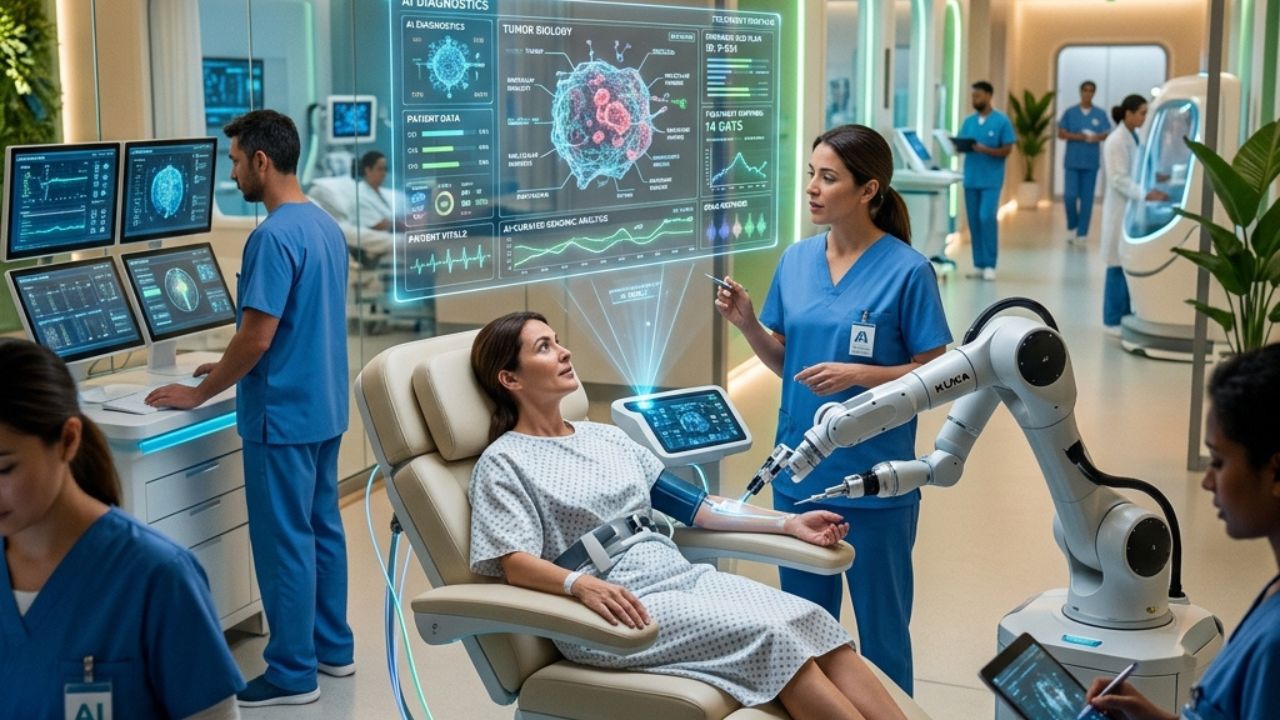
Cancer remains one of the most complex and formidable health challenges we face globally. Millions of people receive a cancer diagnosis each year, prompting medical professionals and researchers to constantly seek better tools for early detection and effective treatment. The sheer volume of medical data—from patient histories and genetic profiles to complex imaging—makes it incredibly difficult for human clinicians to process everything quickly and accurately.
This is exactly why artificial intelligence is stepping into the spotlight within healthcare. The promise of artificial intelligence in healthcare lies in its ability to quickly analyze massive datasets, spot subtle patterns, and provide actionable insights. Medical professionals are beginning to view AI as an indispensable partner in the clinical setting rather than just a futuristic concept.
By integrating these advanced algorithms, the medical community is witnessing a massive shift in oncology. We are seeing artificial intelligence play a critical role across the entire patient journey. From the very first screening to the formulation of personalized treatment plans and long-term survivorship management, algorithms are helping to reshape cancer detection, diagnosis, and treatment as we know it.
AI in Early Cancer Detection
Catching cancer in its earliest stages drastically improves survival rates. Artificial intelligence is supercharging our ability to find these initial signs long before symptoms appear.
Enhancing Imaging Diagnostics (Radiomics)
Medical imaging is a cornerstone of oncology. Now, AI-powered analysis of X-rays, CTs, MRIs, and mammograms is taking radiomics to the next level. Algorithms are trained on millions of historical images, learning to identify the early detection of subtle abnormalities that the human eye might easily overlook. By flagging these tiny irregularities, the technology helps radiologists focus their attention where it matters most, effectively reducing both false positives and false negatives that can lead to unnecessary biopsies or missed diagnoses.
Liquid Biopsies and AI
Traditional biopsies can be invasive and painful. Liquid biopsies offer a less intrusive alternative by analyzing blood samples for cancer markers. AI systems excel at analyzing circulating tumor DNA (ctDNA) and other biomarkers found in the bloodstream. Because these fragments of genetic material are often present in incredibly small amounts, advanced algorithms are necessary to filter out the noise and identify the specific mutations linked to tumors. This allows for non-invasive early detection and continuous monitoring of the disease without subjecting the patient to repeated surgeries.
AI in Pathology
Pathologists spend countless hours examining tissue slides under microscopes to determine if cells are cancerous. AI brings automated analysis of tissue samples into the laboratory workflow. By scanning digital slides at high speeds, machine learning models can highlight suspicious cell clusters, count mitotic figures, and grade tumors with remarkable consistency. This greatly improves diagnostic accuracy and efficiency for pathologists, allowing them to confirm diagnoses faster and start patients on treatment sooner.
AI in Precision Diagnosis and Prognosis
Understanding exactly what type of cancer a patient has, and how it might behave, is critical for effective treatment.
Genomic and Proteomic Analysis
Every tumor has a unique genetic makeup. AI is highly effective at identifying genetic mutations and protein biomarkers hidden within a patient’s DNA. Processing this genomic and proteomic data manually would take an impractical amount of time. Algorithms can quickly map out these mutations, enabling oncologists to develop personalized treatment strategies based on individual tumor profiles rather than relying on a one-size-fits-all approach.
Predictive Analytics for Disease Progression
Knowing how a tumor might behave in the future helps doctors plan accordingly. Researchers are building AI models for forecasting cancer recurrence and patient outcomes by analyzing historical data from thousands of similar cases. These predictive analytics help in guiding treatment intensity and surveillance. If an algorithm predicts a high likelihood of aggressive metastasis, a doctor might recommend a stronger initial therapy.
AI in Personalized Cancer Treatment
Once a diagnosis is confirmed, the focus shifts to eliminating the disease while preserving the patient’s quality of life.
Drug Discovery and Development
Developing new cancer medications is notoriously slow and expensive. AI is changing the landscape by accelerating the identification of new anti-cancer compounds. Machine learning models can simulate how different chemical structures will interact with specific cancer cells, narrowing down millions of potential drugs to a few viable candidates in months instead of years. Furthermore, algorithms are highly effective at repurposing existing drugs, finding new applications for medications already approved for other conditions.
Treatment Planning and Optimization
Radiation therapy requires pinpoint accuracy to destroy tumors while sparing healthy tissue. AI for radiation therapy planning automates the contouring process, mapping the exact shape of the tumor and calculating the optimal radiation dose and delivery angle. Similarly, AI assists in optimizing chemotherapy regimens and dosages based on a patient’s specific metabolic profile. This precision helps in minimizing side effects and maximizing efficacy.
Immunotherapy and AI
Immunotherapy harnesses the body’s immune system to fight cancer, but it doesn’t work for everyone. AI is proving vital in predicting response to immunotherapy by analyzing a patient’s tumor microenvironment and immune biomarkers. By predicting who will benefit from these treatments, doctors can avoid giving ineffective, costly therapies to patients. Additionally, machine learning is continuously identifying novel immunotherapy targets, opening doors for entirely new classes of treatment.
AI in Cancer Management and Survivorship
The battle against cancer does not end when active treatment concludes. Continuous monitoring and support are essential for long-term health.
Remote Patient Monitoring
Wearable devices and AI for tracking patient health are revolutionizing post-treatment care. Smartwatches and medical-grade sensors can monitor vital signs, sleep patterns, and physical activity levels in real time. Algorithms analyze this continuous stream of data, allowing for the early detection of complications and symptom management. If a patient’s heart rate or oxygen levels show concerning trends, the system can automatically alert their healthcare team.
AI-Powered Patient Support Systems
Navigating a cancer diagnosis is emotionally and mentally exhausting. Chatbots and virtual assistants for patient education and support offer 24/7 access to reliable medical information. These systems can answer questions about medication side effects, schedule appointments, and connect patients with support groups. By keeping patients informed and engaged, these tools play a big part in improving patient adherence to treatment plans.
Data Integration and Clinical Decision Support
An oncologist must consider a massive amount of information before making a recommendation. AI platforms that integrate diverse patient data—including electronic health records (EHR), imaging, and genomics—create a comprehensive, unified view of the patient’s health. These clinical decision support systems analyze the aggregated data, providing oncologists with actionable insights for complex cases and ensuring that no vital piece of information slips through the cracks.
Challenges and Ethical Considerations
While the benefits are substantial, integrating these new systems into healthcare comes with significant hurdles.
Data privacy and security remain top priorities. Training powerful algorithms requires massive amounts of sensitive patient data, and hospitals must ensure this information is protected against cyber threats and unauthorized access.
Algorithmic bias and fairness also present a major challenge. If an AI model is trained primarily on data from a specific demographic, it may perform poorly for patients of different ethnicities or socioeconomic backgrounds. Developers must strive to use diverse datasets to prevent widening existing health disparities.
We also face regulatory hurdles and validation of AI models. Health authorities require rigorous clinical trials to prove that these algorithms are safe and effective before they can be deployed in hospitals.
Finally, integration into clinical workflow and physician acceptance cannot be ignored. Doctors are often hesitant to trust a “black box” algorithm. The technology must be transparent, easy to use, and clearly demonstrate its value to gain the trust of the medical professionals relying on it.
The Future of AI in Oncology
The pace of innovation in this field shows no signs of slowing down. Emerging technologies and research directions point toward even more sophisticated neural networks that can analyze complex multi-modal data simultaneously. We will likely see collaborative ecosystems forming, where AI companies, hospitals, and research institutions share data and resources to train globally robust models. Ultimately, these advancements push us closer to the vision of a cancer-free future powered by AI.
Reimagining the Fight Against Cancer
The integration of advanced algorithms into oncology represents one of the most significant medical advancements of our time. From detecting microscopic anomalies on an MRI to tailoring a specific immunotherapy drug to a patient’s unique genetic code, AI is touching every aspect of cancer care.
However, realizing the full potential of this technology requires the imperative for continued innovation and ethical development. We must build systems that are fair, transparent, and secure, ensuring that these life-saving tools are accessible to everyone who needs them.
There is a profound sense of hope and progress in the fight against cancer. As we refine these artificial intelligence tools and integrate them deeper into clinical practice, we equip our medical professionals with the unprecedented ability to save lives, giving millions of patients the chance for a healthier future.