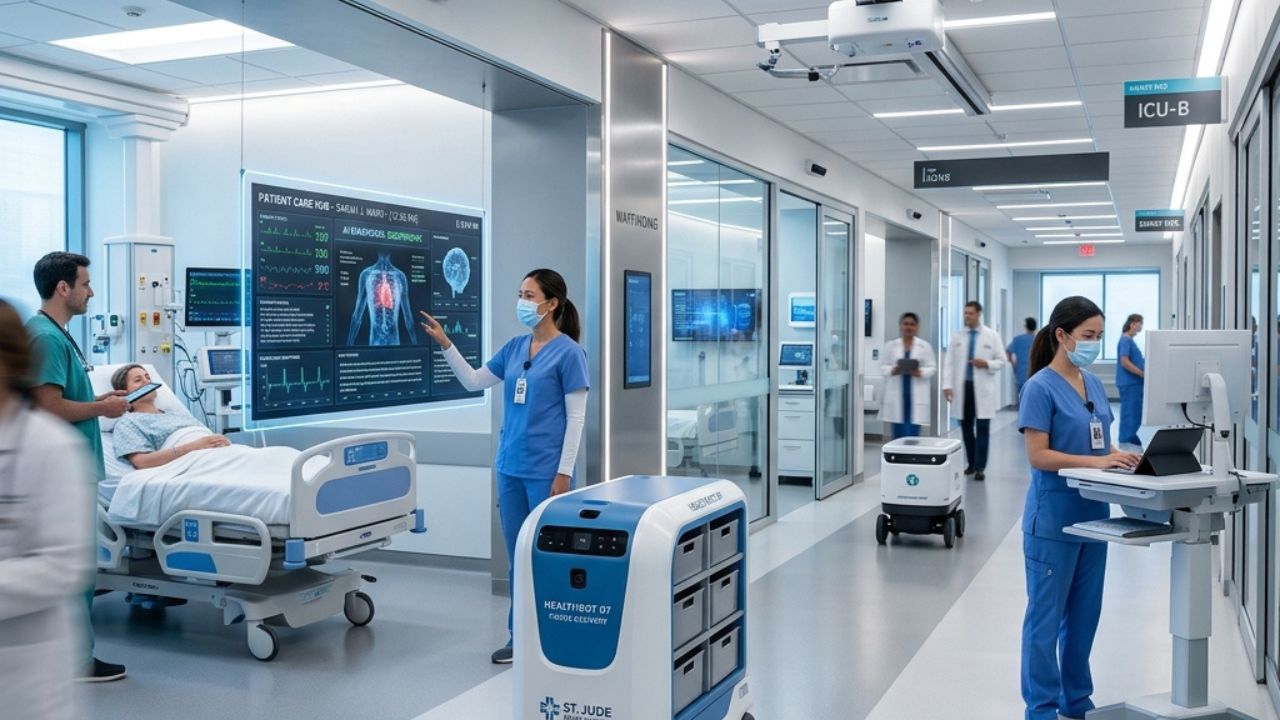
The dawn of a new era in healthcare is here, driven by the rapid emergence of smart hospitals. A smart hospital utilizes advanced digital networks, artificial intelligence, and interconnected medical devices to optimize patient care and streamline operational workflows. Artificial intelligence (AI) serves as the brain of this operation, analyzing massive datasets to predict outcomes and recommend treatments. Digital healthcare encompasses the broader ecosystem of electronic health records, telemedicine, and wearable technology that connects patients to providers outside traditional clinical settings. Together, AI and digital healthcare are fundamentally transforming the future of smart hospitals in the United States, shifting the focus from reactive treatments to proactive, personalized medicine.
American healthcare facilities are standing at a critical crossroads. They must adapt to unprecedented technological advancements while navigating significant systemic hurdles. Understanding this transformation requires a close look at the current medical landscape, the foundational technologies driving change, and the ethical considerations that come with adopting artificial intelligence.
The Current Landscape of US Healthcare
The United States healthcare system currently faces a convergence of severe challenges. Rising operational costs continue to strain hospital budgets, forcing administrators to do more with less. Simultaneously, chronic staff shortages are pushing doctors and nurses to the brink of burnout. An aging population further complicates this dynamic, creating a surge in demand for complex, long-term care that many facilities are unequipped to handle efficiently.
Despite these hurdles, this high-pressure environment has created a fertile ground for innovation. Technological advancements present a clear pathway out of the crisis. By leveraging digital tools, hospitals can pivot toward patient-centric care models that prioritize outcomes and accessibility over sheer volume. Technology offers a unique opportunity to reduce administrative burdens, allowing clinical staff to spend more time directly interacting with patients.
Pillars of Smart Hospitals
To understand how these facilities operate, one must examine the core technologies that form their foundation. A truly smart hospital relies on several interconnected pillars to function effectively.
AI-Powered Diagnostics and Treatment
Artificial intelligence is making its most profound clinical impact in the realm of diagnostics. Precision medicine is becoming a reality, as algorithms analyze a patient’s genetic makeup, lifestyle, and medical history to develop highly personalized treatment plans. In radiology and pathology, AI tools assist doctors by identifying microscopic anomalies in X-rays, MRIs, and tissue samples with incredible speed and accuracy. Predictive analytics take this a step further, flagging patients who are at high risk for conditions like sepsis or heart failure hours before symptoms physically manifest.
Digital Infrastructure and Connectivity
A hospital is only as smart as its network. The Internet of Things (IoT) has introduced thousands of connected devices into the clinical environment, ranging from smart beds that monitor patient movement to wearable biosensors that track vital signs in real time. Remote monitoring extends this connectivity into the patient’s home, reducing readmission rates. At the center of this infrastructure are Electronic Health Records (EHR). True interoperability ensures that a patient’s medical history travels seamlessly with them, accessible to any authorized specialist or primary care provider across the network.
Robotics and Automation
Physical automation is reshaping the hospital floor. Surgical robots are now commonplace, allowing surgeons to perform highly complex, minimally invasive procedures with enhanced precision and control. Beyond the operating room, automation plays a massive role in hospital logistics. Automated pharmacy dispensing systems reduce medication errors and ensure that the right drugs reach the right patients at the correct times. Autonomous mobile robots (AMRs) navigate hospital corridors to deliver linens, meals, and medical supplies, freeing human staff to focus on direct patient care.
AI in Action: Transforming Hospital Operations
Artificial intelligence does more than just diagnose disease. It acts as an invisible administrative engine, optimizing the complex daily operations of massive medical facilities.
Enhancing Operational Efficiency
Managing a hospital involves orchestrating thousands of moving parts. AI streamlines resource allocation by predicting patient admission rates based on historical data, local weather patterns, and public health trends. This allows administrators to optimize staff scheduling and ensure that emergency departments are never caught off guard by a sudden influx of patients. Additionally, predictive maintenance algorithms monitor the health of expensive hospital equipment, such as MRI machines and ventilators, scheduling repairs before a critical failure occurs.
Improving Patient Experience and Outcomes
The hospital experience is notoriously stressful, but AI is helping to ease that burden. AI-powered virtual assistants and chatbots now handle routine patient inquiries, schedule appointments, and provide basic triage advice. This technology empowers patients to take control of their healthcare journey. Furthermore, digital platforms use AI to deliver personalized patient education, ensuring individuals understand their discharge instructions, medication schedules, and rehabilitation exercises, ultimately leading to better long-term health outcomes.
Revolutionizing Research and Development
Smart hospitals are not just centers for healing; they are hubs of scientific discovery. AI is accelerating drug discovery by simulating how different chemical compounds interact with specific diseases, cutting years off the traditional research timeline. In the context of clinical trials, AI algorithms quickly identify suitable candidates by scanning thousands of EHRs, ensuring diverse and appropriate participant pools. This rapid data analysis continuously identifies new treatment pathways, bringing life-saving therapies to market faster than ever before.
Addressing Challenges and Ethical Considerations
The integration of advanced technology into healthcare is not without significant risk. Hospital administrators must navigate a complex web of ethical, legal, and operational challenges to ensure these tools are used responsibly.
Data Security and Privacy
Healthcare data is among the most sensitive information in existence. Maintaining strict HIPAA compliance is mandatory, requiring hospitals to deploy military-grade cybersecurity measures to protect patient records from ransomware attacks and data breaches. Beyond security, there is the pressing issue of algorithmic bias. If an AI model is trained on historical data that reflects systemic healthcare inequalities, it will inevitably perpetuate those biases. Hospitals must rigorously test and audit their algorithms to ensure fair and equitable treatment recommendations for all demographic groups.
Workforce Training and Adaptation
Technology is only useful if the staff knows how to use it. Integrating AI requires a massive upskilling effort across the healthcare workforce. Doctors, nurses, and technicians must be trained not just to operate new software, but to interpret AI-generated insights critically. The goal is not to replace clinical staff but to establish effective human-AI collaboration models. Healthcare professionals must remain the ultimate decision-makers, using AI as a powerful supplementary tool rather than an infallible oracle.
Regulatory Landscape and Policy
The regulatory environment is struggling to keep pace with digital innovation. The FDA faces the monumental task of evaluating and approving AI-powered medical devices that continuously learn and evolve. Clear guidelines are necessary to ensure these dynamic systems remain safe and effective over time. Furthermore, the financial sustainability of digital healthcare depends on updated reimbursement models. Insurance companies and Medicare must establish clear frameworks for compensating hospitals that provide remote monitoring, telehealth consultations, and AI-driven preventative care.
Case Studies: Early Adopters and Success Stories
Several leading US healthcare institutions are already demonstrating the immense potential of smart hospital technology.
At the Cleveland Clinic, AI and machine learning models are deeply integrated into cardiovascular care. By analyzing massive datasets from EHRs and patient monitors, their predictive algorithms can identify patients at risk of critical cardiac events with remarkable accuracy. This early intervention approach has significantly reduced mortality rates and intensive care unit (ICU) length of stay.
Similarly, Johns Hopkins Hospital has implemented a sophisticated digital command center. Using predictive AI, this centralized hub monitors hospital capacity, patient flow, and resource utilization across the entire health system. The results are highly quantifiable: they have seen a dramatic reduction in emergency department wait times, optimized surgical scheduling, and improved overall bed management, proving that AI is a highly effective tool for massive logistical operations.
The Future Vision: A Seamless Healthcare Ecosystem
The ultimate goal of the smart hospital movement extends far beyond the four walls of the clinic. The future envisions a seamless healthcare ecosystem where smart hospitals are deeply integrated with broader community health initiatives. By sharing anonymized health data with public health agencies, smart networks can track disease outbreaks and allocate regional resources effectively.
This ecosystem will lean heavily into preventative care. Continuous monitoring via wearable technology will alert doctors to minor physiological changes before they escalate into medical emergencies. Patients will receive proactive interventions in their homes, reducing the need for costly hospital admissions and dramatically improving the overall quality of life for the population.
Shaping an Intelligent, Patient-Centered Future
The transformative power of artificial intelligence and digital healthcare is redefining what it means to operate a medical facility in the United States. By leveraging AI-powered diagnostics, robust digital infrastructure, and robotic automation, smart hospitals are successfully confronting the challenges of rising costs and staffing shortages.
As the regulatory landscape matures and workforce training catches up to the technology, the barriers to adoption will continue to fall. The evidence from early adopters clearly demonstrates that these tools can drastically improve operational efficiency, expand medical accessibility, and most importantly, save lives. The future of healthcare is intelligent, fully integrated, and unequivocally patient-centered, ensuring that the focus remains exactly where it belongs: on healing the human being.